
Is every litre at your fuel station accounted for?
Twelve questions on how your station measures, receives, sells and reconciles its wet stock (the fuel in your tanks), including rules from EWURA, the Weights and Measures Agency (WMA) and TRA. Enter your email and phone number at the end to see your score and a list of your gaps with practical fixes, and we email you the action plan.
- 12 questions
- About 4 minutes
- Instant score
Fuel station health check
- Daily stock reconciliation and tank gauging
- Delivery checks and water detection
- Tank calibration and daily pump tests
- EFPP receipts, electronic payments and shift handovers
- CCTV, record keeping and management review
12 questions · About 4 minutes · Instant score
What this health check covers
01 · Stock control
Do you reconcile every tank every day: opening stock plus deliveries minus pump sales, compared with the stock you measure?
EWURA’s rules require licensed stations to monitor, record and reconcile all stock delivered, stored and dispensed. Without a daily figure, a leak, theft or meter fault can run for weeks before anyone notices.
02 · Stock control
Is the level in every tank measured and recorded at least once a day, by an automatic tank gauge (ATG) or by dipping?
Reconciliation can only be as accurate as the stock figure it starts from. Unrecorded or careless dips make losses impossible to prove, and manual dipping is still the reference WMA uses to verify an ATG.
03 · Stock control
Is every delivery checked by measuring the tank before and after offloading and comparing the litres received with the delivery note?
A short delivery is only found by measuring it. WMA’s ATG guidelines note that ATG data helps confirm that the volume delivered matches the quantity ordered.
04 · Tanks & pumps
Do you check every tank for water regularly, and investigate when water appears or rises?
WMA’s guidelines note that the water level helps identify tank leaks or contamination. Water that reaches the pumps ends up in customers’ vehicles.
05 · Tanks & pumps
Does every tank have its WMA calibration certificate and chart, with periodic verification up to date?
Every litre figure comes from the tank’s calibration table, so a wrong table gives a wrong stock figure however carefully you measure. WMA’s regulations call for a calibration certificate, periodic verification every five years and recalibration after any accident, deformation or refabrication.
06 · Tanks & pumps
Are your pumps verified and sealed by WMA, and tested every morning with a verified check measure of at least 20 litres?
Your sales figure is only as good as your meters. WMA’s regulations require fixed fuel pumps to be verified, sealed and fitted with a verification sticker, and the owner or user to check their accuracy with a verified check measure of at least 20 litres every day before business starts.
07 · Sales & receipts
Does every pump sale produce a fiscal receipt through an electronic fiscal pump printer (EFPP) connected to the pump?
The EFPP is TRA’s fiscal device type for petrol stations: it is connected to the pump and prints a receipt for every sale. Fuel dispensed without a receipt breaks the receipt rule and opens a gap between your meters and TRA’s records.
08 · Sales & receipts
Can customers pay electronically at every pump, and are card and mobile money takings matched to sales every shift?
Under the Electronic Transactions (Mandatory Electronic Payments for Specified Transactions) Order, 2026, in operation from 1 July 2026, payment at filling stations must be made or received electronically, for example by mobile money, card or point of sale device. Payments that are not matched to sales hide both mistakes and theft.
09 · Sales & receipts
At every shift change, are pump meter readings recorded and the takings counted against them, with both attendants signing?
Without meter readings at each handover, a shortage of fuel or cash cannot be traced to a shift or an attendant.
10 · Security & oversight
Do CCTV cameras cover the pumps, the cash point and the offloading point, with recordings kept long enough to review an incident?
Without footage, a disputed delivery, a customer who drives off without paying or a cash shortage comes down to one person’s word against another’s.
11 · Security & oversight
Do you keep stock records for at least twelve months and report unusual losses or gains to EWURA?
EWURA’s rules require licensees to keep their stock records for at least twelve months, show them to EWURA on demand and promptly notify EWURA of any apparent loss or gain outside normal operating patterns.
12 · Security & oversight
Does the owner or manager review the stock, sales and variance reports at least once a week and follow up every unexplained difference?
Records only protect you if someone reads them. A difference that keeps growing in one direction points to a leak, theft or a metering fault, and it keeps costing you until someone acts.
Good to know: This check gives general guidance on stock control at fuel stations, with rules taken from EWURA, WMA and TRA publications; it is not an inspection, an audit or legal advice. Confirm the requirements for your licence with EWURA and WMA, and in Zanzibar check the rules that apply there, including ZRA’s VFMS for receipts.
Automatic tank gauging (ATG)
Dover ProGauge automatic tank gauging for fuel stations, with ATEX-rated probes, installed and supported by Powercomputers.
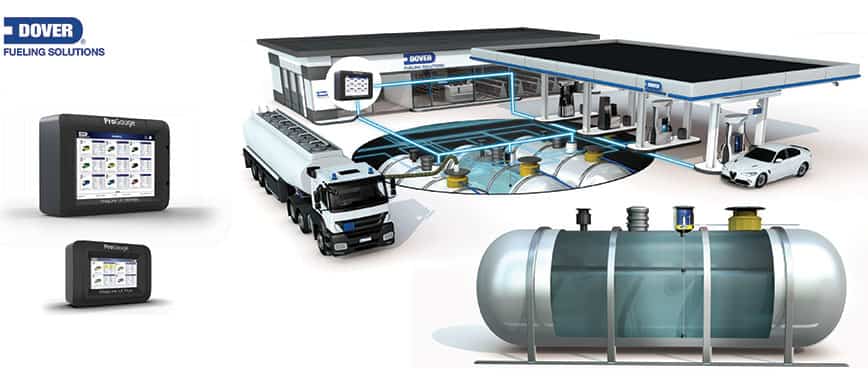
- Dover ProGauge
- WMA · EWURA · TAPSOA
- ATEX-rated probes
- Tanzanian IT company since 2001
- Branch offices across Tanzania
Often bought together: EFD machines, Vehicle tracking
Questions
It is the daily sum that shows whether fuel is going missing. Opening stock, plus deliveries, minus pump sales, gives the stock you should have, which you compare with the stock you measure in each tank. Small differences come and go with temperature and meter tolerances, but a difference that keeps growing in one direction points to a leak, theft or a metering fault.
Yes, keep your dipsticks. Under WMA’s guidelines an installed ATG is verified against a manual reference level measurement, so manual dipping remains the reference, and it is your fallback if the gauge fails. Compare the ATG with a careful manual dip from time to time, and make sure more than one person can dip a tank properly.
EWURA’s rules require licensees to keep records of stock delivered, stored and dispensed for at least twelve months and to show them to EWURA on demand. The same rules require you to monitor, record and reconcile stock as EWURA directs, and to notify EWURA promptly of any apparent loss or gain outside normal operating patterns.
The electronic fiscal pump printer (EFPP), which TRA describes as designed for petrol stations: it is connected to a pump and prints a receipt for every sale. Since 1 July 2026, payment at filling stations must also be made or received electronically, so plan how EFPP receipts and electronic payments are matched each shift. In Zanzibar, receipts go through ZRA’s VFMS.
More free health checks
IT health check
Twelve quick questions on backups, security, power protection, equipment and support. Enter your email and phone number at the end to see your score and a list of your gaps with practical fixes, and we email you the action plan.
Cyber security check
Twelve quick questions on your firewall and Wi-Fi, passwords, staff awareness, updates and backups. Enter your email and phone number at the end to see your score and a list of your gaps with practical fixes, and we email you the action plan.
EFD & VFD compliance check
Twelve quick questions on how your business issues fiscal receipts with an EFD or VFD in Mainland Tanzania. Enter your email and phone number at the end to see your score and a list of your gaps with practical fixes, and we email you the action plan.
Want help fixing these gaps?
Powercomputers has supported Tanzanian businesses since 2001. Tell us your score and we’ll suggest what to fix first.