
Fuel station loss calculator: what unexplained losses cost
Turn the unexplained loss from your stock reconciliation into litres and shillings per month and per year, and see what cutting it by a share you choose would be worth.
All products together, or one product at a time for a closer look.
From your own reconciliation: the month’s unexplained shortfall divided by the litres sold.
Your purchase cost shows what the lost stock cost you; your pump price shows the sales it represents.
Your own target, for example with daily reconciliation and automatic tank gauging.
Example values: change them to your own.
Your result
Fuel lost per year
TSh 27,000,000
9,000 litres a year
Fuel lost per month
TSh 2,250,000
750 litres a month
Cutting the loss by 50% would save
TSh 13,500,000
TSh 1,125,000 a month
- Litres sold per month
- 150,000
- Litres lost per month
- 750
- Value lost per month
- TSh 2,250,000
- Litres lost per year
- 9,000
- Value lost per year
- TSh 27,000,000
The working
5,000 litres × 30 days = 150,000 litres a month. 150,000 litres × 0.5% = 750 litres lost a month, and × TSh 3,000 = TSh 2,250,000 a month, or TSh 27,000,000 a year.
Automatic tank gauging (ATG)
Dover ProGauge automatic tank gauging for fuel stations, with ATEX-rated probes, installed and supported by Powercomputers.
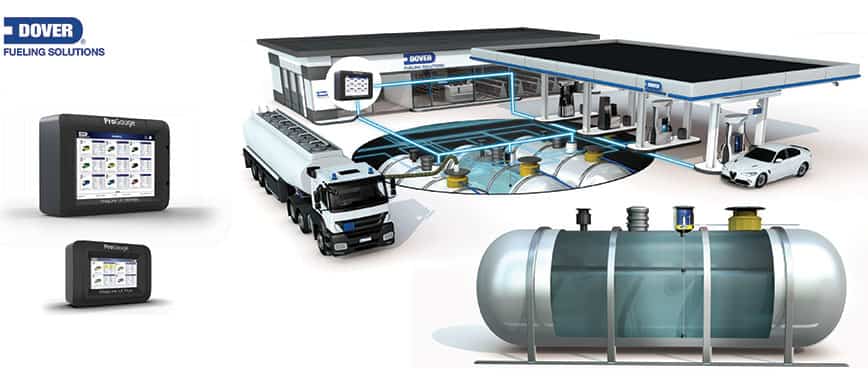
- Dover ProGauge
- WMA · EWURA · TAPSOA
- ATEX-rated probes
- Tanzanian IT company since 2001
- Branch offices across Tanzania
Often bought together: EFD machines, Vehicle tracking
How it works
Litres lost are the litres sold multiplied by your unexplained loss percentage. If you enter sales per day, the month’s sales are the litres per day multiplied by the days you open. The value lost is the litres lost multiplied by the value per litre, and a year is twelve months. A station selling 5,000 litres a day for 30 days sells 150,000 litres a month; an unexplained loss of 0.5% is 750 litres, worth TSh 2,250,000 a month at an example value of TSh 3,000 a litre, or TSh 27,000,000 a year.
The loss percentage comes from your own reconciliation. Opening stock plus deliveries minus pump sales gives the stock you should have, and the difference from the stock you measure, by dipping or with an automatic tank gauge (ATG), is your gain or loss. Small differences come and go with temperature and meter tolerance; a difference that keeps growing in one direction points to a leak, theft or a metering fault.
EWURA’s Petroleum (Wholesale, Storage, Retail and Consumer Installation Operations) Rules, 2022 require every licensee to keep storage tanks, flow meters and dispensing pumps calibrated; to monitor, record and reconcile all stock delivered, stored and dispensed as EWURA directs in writing, keeping the records for at least twelve months; and to notify EWURA promptly of any apparent loss or gain outside normal operating patterns. Neither the rules nor their 2025 amendment give a percentage for a normal loss.
The value of cutting the loss is the value lost multiplied by the share you choose, which is your own target. An ATG helps you work towards it by measuring the fuel level, water level and temperature in every tank continuously and turning each level into litres with the tank’s calibration table, so reconciliation can be done every day.
Assumptions
- The loss percentage is your own reconciliation figure, applied evenly to every litre sold.
- Sales and the value per litre stay the same each month, and a year is twelve months.
- The share of the loss you aim to cut is your own target, not a promise.
This is an estimate based on the numbers you enter. It is not a quote or professional advice.
Questions
Add the deliveries to your opening stock and subtract the pump sales to get the stock you should have, then compare it with the stock you measure by dipping or with an ATG. The difference is your gain or loss. Divide the month’s unexplained loss by the litres sold to get the percentage this calculator asks for, and value it at your cost or pump price.
EWURA’s petroleum rules don’t give a percentage. They require licensees to monitor, record and reconcile stock, keep the records for at least twelve months and promptly notify EWURA of any apparent loss or gain outside normal operating patterns. Small daily differences from temperature and meter tolerance come and go; a difference that keeps growing in one direction points to a leak, theft or a metering fault.
They can come from leaks in tanks or pipework, theft, short deliveries, pump meters that measure wrongly, or stock figures worked out from a wrong tank calibration table. WMA’s General Regulations require the owner or user of a fuel pump to check its accuracy every day before business starts with a verified measure of at least 20 litres, and checking each delivery against the quantity ordered catches short deliveries.
An ATG measures the fuel level, water level and temperature in every tank continuously and turns each level into litres with the tank’s calibration table, so you can reconcile every day instead of waiting for manual dips. Unusual movements and growing differences show up sooner, while there is still time to investigate. Powercomputers supplies and installs Dover ProGauge ATG systems, with calibration, training and support.
More free tools
Automatic tank gauging (ATG)
Dover ProGauge automatic tank gauging for fuel stations, with ATEX-rated probes, installed and supported by Powercomputers.
Fuel station health check
Twelve questions on how your station measures, receives, sells and reconciles its wet stock (the fuel in your tanks), including rules from EWURA, the Weights and Measures Agency (WMA) and TRA. Enter your email and phone number at the end to see your score and a list of your gaps with practical fixes, and we email you the action plan.
Automatic tank gauging (ATG) for fuel stations, explained
An ATG measures the fuel and water in every tank and turns each level into litres using the tank’s calibration table. How the probes work, how reconciliation exposes losses, and what WMA and EWURA rules say.
Fuel cost calculator
The fuel cost of a trip or a month of driving, and the cost per kilometre.
13 ways to prevent fuel losses at a filling station
Find and stop losses in deliveries, tanks, pumps and payments with daily reconciliation, routine checks and automatic tank gauging.
Fleet fuel savings calculator
What a cut in fuel use you choose would save your fleet each month and each year.
Want exact figures for your business?
Send us your numbers and the Powercomputers team will come back with options and a quote.