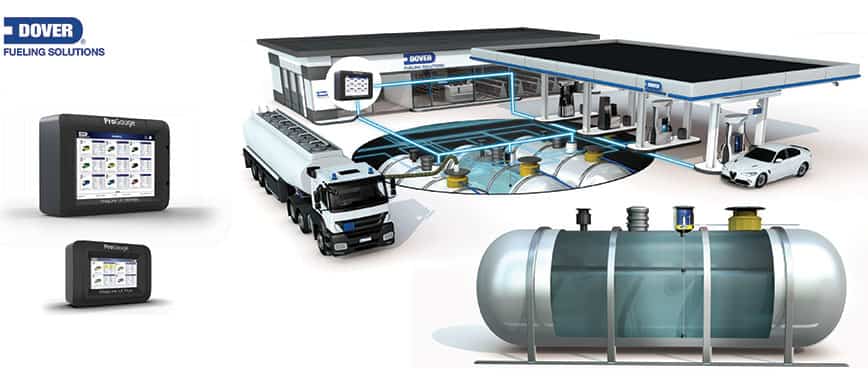
Automatic tank gauging (ATG) for fuel stations, explained
An ATG measures the fuel and water in every tank and turns each level into litres using the tank’s calibration table. How the probes work, how reconciliation exposes losses, and what WMA and EWURA rules say.
By the Powercomputers team · 21 November 2026 · 7 min read
The short answer
An automatic tank gauge (ATG) is a probe in each fuel tank, linked to a console, that measures the fuel level, water level and temperature continuously and converts each level into a volume using the tank’s calibration table. Comparing that measured stock with deliveries and pump sales shows losses or gains quickly. In Tanzania, WMA’s ATG guidelines set out how a gauge is approved, installed and verified, and EWURA’s rules require licensed stations to record and reconcile stock as EWURA directs.
Key points
- Probes measure the fuel level, water level and temperature in each tank and send the readings to a console.
- The level becomes litres through the tank’s calibration table, so a wrong table gives a wrong stock figure.
- Reconciliation compares deliveries, pump sales and measured stock; a difference that keeps growing needs investigating.
- WMA’s ATG guidelines allow an installed gauge an error of no more than 4 mm, checked against a manual reference measurement.
- EWURA’s rules require stock to be recorded and reconciled, records kept for at least twelve months and unusual losses or gains reported.
- Choose an approved ATG type rated for hazardous areas, with training and maintenance included.
What an ATG is
An automatic tank gauge cuts down on manual dipping by measuring every tank continuously. WMA’s guidelines for ATGs at petroleum depots and retail stations describe three parts: probes and sensors inside the tanks, which monitor product level, temperature, water level and other conditions; a control console, where operators view real-time data, receive alerts and generate reports; and software for data processing, trend analysis and remote monitoring.
The same guidelines name three technologies: radar, suited to large tanks; magnetostrictive probes, commonly used for underground tanks and measuring fuel and water levels with high accuracy; and hydrostatic pressure, which is cost-effective but less precise in large tanks. Dover’s ProGauge probes, which Powercomputers supplies, are magnetostrictive.
How the probe measures fuel and water
A magnetostrictive probe reaches down into the tank, with floats that rise and fall with the liquid. Dover describes its probes as sending a high-frequency electrical impulse and timing how long the signal takes to return from the float, giving a continuous, accurate level reading that goes to the console on site or directly to the point-of-sale system.
Typically, one float rides on the fuel surface and a second, weighted float sinks through the fuel to rest on any water at the bottom. Dover also offers in-tank floats that detect water contamination and phase separation and measure fuel density. Temperature matters too: WMA’s guidelines point out that it is critical for density calculations, because fuel volume changes with temperature.
The probe measures height, not litres. The console turns each height into a volume using the tank’s calibration table, which WMA’s fixed storage tank regulations define as the relationship between liquid height and volume in that tank. So the tank’s calibration matters as much as the gauge: a wrong table gives a wrong stock figure however precise the probe. When WMA verifies a fixed storage tank, it checks the calibration charts, fills the tank with a known quantity of liquid and tests for leaks.
Reconciliation: where losses show up
Reconciliation is a simple sum done carefully: opening stock, plus deliveries, minus pump sales, gives the stock you should have. Compare that with what the ATG measures. Small differences come and go, because fuel expands and contracts with temperature and every meter has a tolerance; a difference that keeps growing in one direction points to a leak, theft or a metering fault.
An ATG makes this practical every day. Dover describes its ProGauge MagLink LX consoles as monitoring the fuel delivered into each tank and the quantity sold through the dispensers in real time, showing actual stock variance, and supporting inventory reconciliation and loss prevention analysis. WMA’s guidelines add that ATG data helps verify that the volume delivered matches the quantity ordered, which is where short deliveries come to light.
The pumps need checking too, because the sales figure is only as good as the meters. WMA’s general regulations require the owner or user of a fuel pump to keep a verified check measure of at least 20 litres and use it to check the pumps’ accuracy every day before business starts.
Alarms and early warnings
Because the probe never stops measuring, the console can warn you the moment something changes. WMA’s guidelines require the gauge’s indicating device to sound an alarm when the operational limits of the level gauge are reached, at the maximum and minimum heights, which helps catch an overfill during a delivery or a tank running low.
Watching the water level matters as much: WMA’s guidelines note that it helps identify tank leaks or contamination, and Dover offers environmental sensors that watch for leaks and water ingress around the site. Remote alerts, which Powercomputers lists among the benefits of its ATG solution, keep managers informed about tank conditions even when they are away from the station.
What Tanzanian rules say
EWURA’s Petroleum (Wholesale, Storage, Retail and Consumer Installation Operations) Rules, 2022, as amended in 2025, set general obligations for every licensee, retail stations included. Licensees must keep storage tanks, flow meters and dispensing pumps calibrated for correct measurement and in good working condition; monitor, record and reconcile all stock delivered to, stored in and dispensed from the facility, as EWURA directs in writing; keep those records for at least twelve months and show them to EWURA on demand; and promptly notify EWURA of any apparent loss or gain outside normal operating patterns. Since 2025, any additional installation at a facility, including storage tanks and dispensing pumps, also needs EWURA’s written approval first.
WMA’s rules cover the measuring side. Under its fixed storage tank regulations, a tank must carry a calibration information plate and is issued a calibration certificate after calibration; periodic verification is due at the end of every five years; and a tank must be recalibrated after any accident, deformation or refabrication that could change its measurements, with the owner informing WMA. Under WMA’s general regulations, fixed fuel pumps must be verified, sealed and fitted with a verification sticker.
For the gauge itself, WMA has issued ATG installation guidelines for depots and retail stations, and a WMA list of approved ATG patterns is published on EWURA’s website. The gauge must carry its type approval mark. Initial verification has two stages: before installation, against its approved type; and after installation, when it must read within 4 mm of a manual reference level measurement before it is stamped and sealed. Parts and settings that affect measurement must be sealed; where the seal is electronic, an event log must record each change, its date, the new value and who made it. The owner must keep the gauge working properly and document regular inspections by the authority, the manufacturer or another competent expert.
Choosing and installing an ATG
Start with a site survey: how many tanks you have, their size and shape, what each holds, where the console and cabling will go, and whether the tanks’ calibration charts are current. WMA’s guidelines list tank size and type, accuracy, scalability and vendor support among the things to weigh when choosing a system.
Ask for the exact model and its WMA pattern approval, and check that the equipment is rated for hazardous areas. Fuel storage areas can contain flammable vapours, and WMA’s guidelines call for flexibility for both intrinsically safe and explosion-proof installations. Dover, for example, lists ATEX and IECEx among the certifications for its ProGauge DMP MagRF wireless unit and describes it as intrinsically safe for installation in Zone 1 of a forecourt.
Finally, budget for people as well as hardware: training so staff can read tank data and respond to alarms, and a maintenance arrangement so the system stays accurate and its inspections are documented.
How Powercomputers can help
Powercomputers provides Dover ProGauge automatic tank gauging for fuel stations and petroleum businesses in Tanzania, giving accurate, real-time information about the fuel stored in underground tanks. The benefits it lists include real-time fuel levels, faster reconciliation of deliveries, sales and stock, reliable tank records for reporting and inspections, remote alerts, and early detection of unusual fuel movements and unexplained inventory differences. It notes that Dover’s ATG solutions use ATEX-rated probes designed for hazardous fuel storage environments.
Its service covers the whole job: site survey and assessment, installation and commissioning, calibration, training on reading tank information and responding to alerts, and ongoing maintenance and technical support, with genuine Dover equipment. Powercomputers says it can provide an ATG solution for a single fuel station or for multiple locations.
Frequently asked questions
No. Under WMA’s guidelines, an installed ATG is verified by comparing its readings with a manual reference level measurement, so manual dipping remains the reference. Keep your dipsticks and make sure staff can still dip a tank properly.
WMA’s guidelines set a maximum permissible error of 1 mm either way for the gauge before installation and 4 mm either way once it is installed on the tank. The volume it reports also depends on the accuracy of the tank’s calibration table.
EWURA’s rules require licensees to keep their records of stock delivered, stored and dispensed for at least twelve months and to make them available to EWURA on demand.
Yes. WMA’s guidelines describe magnetostrictive probes as measuring water level as well as fuel level, and note that water level helps identify leaks or contamination. Dover also offers floats that detect water contamination and phase separation.
That depends on the tanks and the site, which is what a site survey establishes. Powercomputers’ ATG service starts with an inspection of your site and tank setup before installation.
Sources
This guide was written from these pages:
- Powercomputers: Automatic Tank Gauging (ATG) Solutions
- WMA: Guidelines for Installation of Automatic Tank Gauging (ATGs) at Petroleum Facilities (PDF, published by EWURA)
- WMA: List of Approved Patterns for ATGs (PDF, published by EWURA)
- EWURA: Regulatory Tools (petroleum)
- EWURA: The Petroleum (Wholesale, Storage, Retail and Consumer Installation Operations) Rules, 2022, GN 150 (PDF)
- EWURA: The Petroleum (Wholesale, Storage, Retail and Consumer Installation Operations) (Amendment) Rules, 2025, GN 112 (PDF)
- WMA: Weights and Measures (Fixed Storage Tank) Regulations, GN 533 of 1998, as amended (PDF)
- WMA: Weights and Measures (General) Regulations, GN 288 of 2019 (PDF)
- WMA: Fixed Storage Tank (FST) Verification
- Dover Fueling Solutions: Automatic Tank Gauging (Middle East and Africa)
- Dover Fueling Solutions: Probes
- Dover Fueling Solutions: Consoles (ProGauge MagLink LX family)
- Dover Fueling Solutions: ProGauge DMP MagRF