
Attendance savings calculator: the cost of lateness and timesheets
See what unrecorded late arrivals, early departures and manual timesheets cost your business each month and each year, and what cutting a share of that cost would save. Every figure is your own.
Gross pay, or the full cost of employment if you know it.
For example, 8 hours a day for 22 days is 176 hours.
Your estimate of the average per employee per working day.
Collecting, checking and typing attendance into payroll.
The monthly pay of the person doing it divided by their working hours.
Your own assumption about what accurate, automatic attendance records would remove.
Example values: change them to your own.
Your result
Cost per year
TSh 11,920,000
TSh 993,333 a month
Saving 50% of it would be worth
TSh 5,960,000
TSh 496,667 a month
- Cost of an employee hour
- TSh 4,545
- Unrecorded hours per month
- 183.3 hours
- Unrecorded time per month
- TSh 833,333
- Manual timesheets per month
- TSh 160,000
- Cost per month
- TSh 993,333
- Cost per year
- TSh 11,920,000
The working
TSh 800,000 ÷ 176 hours = TSh 4,545 an hour. Unrecorded time (employees × minutes a day × working days ÷ 60): 50 × 10 × 22 ÷ 60 = 183.3 hours a month, × TSh 4,545 = TSh 833,333. Timesheets: 20 hours × TSh 8,000 = TSh 160,000 a month.
Biometrics & access control
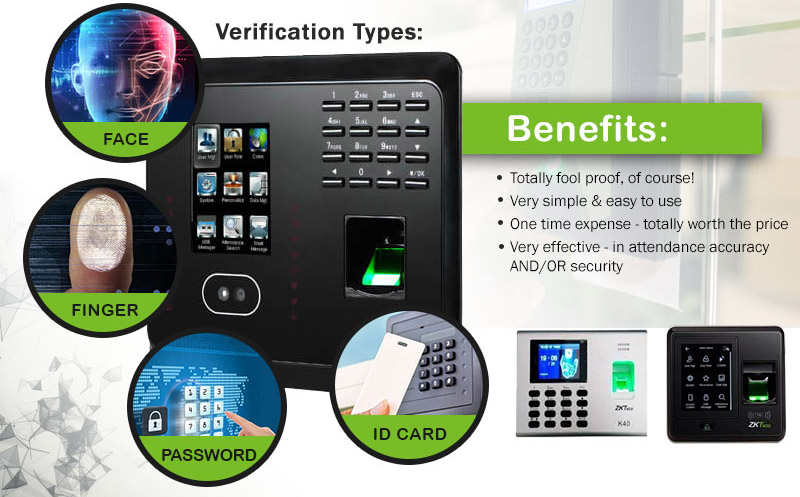
Face and fingerprint attendance, door access and smart locks: more than 250 installations across Tanzania.
- 250+ installations
- Face, finger & card
- Links to payroll
- Tanzanian IT company since 2001
- Branch offices across Tanzania
Often bought together: Payroll & HR software, CCTV security cameras, Repairs, networking & AMC
How it works
An employee hour costs the average monthly pay divided by the working hours in a month. Unrecorded time is the number of employees multiplied by the minutes lost per employee each working day and by the working days, divided by 60 to give hours, and its cost is those hours multiplied by the hourly cost. With 50 employees paid TSh 800,000 for 176 hours, an hour costs about TSh 4,545; ten minutes a day over 22 days is about 183 hours a month, or roughly TSh 833,000.
Manual timesheets cost the HR hours spent on them each month multiplied by the cost of an HR hour. The two costs are added for the month and multiplied by twelve for the year, and the saving is that total multiplied by the share you choose.
The calculator is pure arithmetic on your own figures: the minutes and the share are your estimates, and no outside rate is used. The one source cited is Tanzania’s Personal Data Protection Act, because biometric attendance collects data that the Act treats as sensitive.
A biometric terminal identifies each employee by face, fingerprint, card or PIN and records the time of every clock-in, and the attendance software turns those records into hours worked, late arrivals, early departures, absences and overtime by your shift rules. Powerpay, Powercomputers’ payroll software, supports biometric attendance devices, so the hours reach payroll without retyping. Agree the rules first: shift times, any grace period, how overtime is approved and what happens when someone forgets to clock out.
Assumptions
- Every employee costs the average hourly rate.
- Lateness and early leaving are your estimate, the same on every working day.
- A year is twelve months of the same pattern.
- The share you could save is your own assumption, not a promise. The cost of a system isn’t included: compare it with a quote.
This is an estimate based on the numbers you enter. It is not a quote or professional advice.
Questions
Divide monthly pay by the hours worked in a month. An employee paid TSh 800,000 for 176 hours, which is 8 hours a day for 22 days, costs about TSh 4,545 an hour. For the full cost of employment, add the employer’s statutory contributions and any allowances to the pay before you divide, and use the same figure for every calculation you compare.
Multiply the minutes lost per employee each day by the number of employees and the working days, divide by 60 and multiply by the hourly cost. With 50 employees losing 10 minutes a day over 22 days, that is about 183 hours a month; at TSh 4,545 an hour, it comes to roughly TSh 833,000 a month, or TSh 10 million a year.
Each employee clocks in and out at a terminal by face, fingerprint, card or PIN, and the attendance software turns the time stamps into hours worked, late arrivals, early departures, absences and overtime by your shift rules. A face or fingerprint can’t be lent to a colleague, so clocking in for someone else is much harder, and Powerpay can take the hours straight into payroll.
Generally, yes. Tanzania’s Personal Data Protection Act lists biometric data as sensitive personal data, and section 30 says it must not be processed without the person’s prior written consent, which they can withdraw at any time, subject to exceptions listed in the Act. Collect written consent, explain the purpose, offer a card or PIN as a fallback and take legal advice.
More free tools
Biometrics & access control
Face and fingerprint attendance, door access and smart locks: more than 250 installations across Tanzania.
Payroll & HR software
Powerpay automates salaries, PAYE and statutory contributions, leave, loans, payslips and biometric attendance.
Biometric time and attendance: how it works and what to look for
A biometric terminal records who clocked in and when, using a face, fingerprint, card or PIN. How the system works, how attendance differs from door access, how it feeds payroll and what to check before buying.
Accounting time savings calculator
The hours manual bookkeeping takes each month, and what automating it could free up.
12 ways to save time on payroll and attendance
Replace attendance books and manual payroll with biometric clock-ins, payroll software and a simple monthly checking routine.
Margin and markup calculator
Turn a cost and a selling price into margin and markup, or find the price for the margin you want.
Want exact figures for your business?
Send us your numbers and the Powercomputers team will come back with options and a quote.